 This guest post written by Charlotte Matoussowsky is part of this blog’s series on MA courses in Translation and Interpreting (currently divided into European and Non-European sections). If you have done an MA relatively recently and would be interested in writing about your experience to help future students, then please get in touch. You’ll find more information about writing for this blog and a list of all guest posts here.
As a former student of ISIT (whose Translation MA was thoroughly described by Maëlys De Santis here) in France, I spent my last year (2013-2014) within the framework of the METS programme (Master Européen de Traduction Spécialisée), much as Julie Zabinski did, who described her own experience here. I spent one semester in Swansea (Wales, UK) and one semester in Forlì (University of Bologna, Italy). Since my experience overlaps the others’, I will try to focus on what has not been said yet.
Continue reading
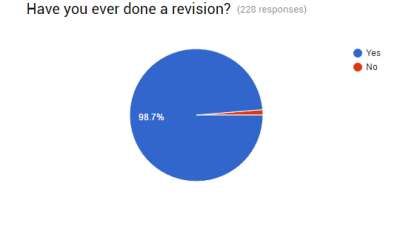 Back in July and August I ran a survey on revisions (one of my favourite topics!) using Google Forms to try to get an idea of colleagues’ experiences with and attitudes to revision.
 In 2011, I found myself in the same situation as many other students: nearing the end of my undergraduate degree – in my case, a BA (Hons) in French and Spanish – and unsure of what to do next. I had really enjoyed the translation modules during my course, so I decided to continue down this road, and, a few months later, began my year-long
  In August I rediscovered what an exceptionally beautiful part of the world the Lake District is (we were blessed with sunshine throughout our stay, however). Now that Brexit has probably scuppered my plans of moving back to the Continent to retire near the lakes in northern Italy to be close to family, I might just end up in the Lake District instead.
 Today’s guest post has been written by
 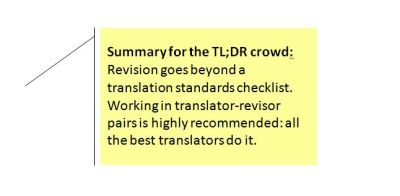 This guest post cannot possibly say everything about revision and does not need to. Nikki Graham has already grouped together a number of revision-related blogs worth reading
  This MA course review is written by Nathalie Verschelden. For more information on MA courses and links to other reviews, see the
  Early July I had the immense good fortune to translate a short piece about Grace Jones who gave us one of my all-time favourite songs: ‘Slave to the Rhythm’. Immersing myself in her music again after far too long an absence (I think it’s essential to listen to the music of the artists I translate about to help the creative juices flow in the right direction) was not only uplifting after all the political bad news (Brexit), but also reminded me about her strong personality and how she broke the moulds.
 Back in October 2014 on my old blog I wrote about some reasons why an agency might stop working with you. As both the original post and the
  Nikki Graham - Translation & Editing Services